Saturday, December 10, 2016

The Specs for Techs

Think Super Speeds are confusing? Let's talk Techs...

Introduced in 1938, the Tech is a simple three-piece razor consisting of a handle, base plate, and cap. Should be easy, right? Well...

Is the cap plain, etched, or embossed with Gillette's logo? Brass, steel, Zamak, or aluminum? Heavy handle, ball-end, fluted, or Bakelite? Standard length or short "Travel" size? Gold or nickel? Pre-war triangular drain holes or post-war oblong holes? English, US, French, Argentinian, German? Date code or no?

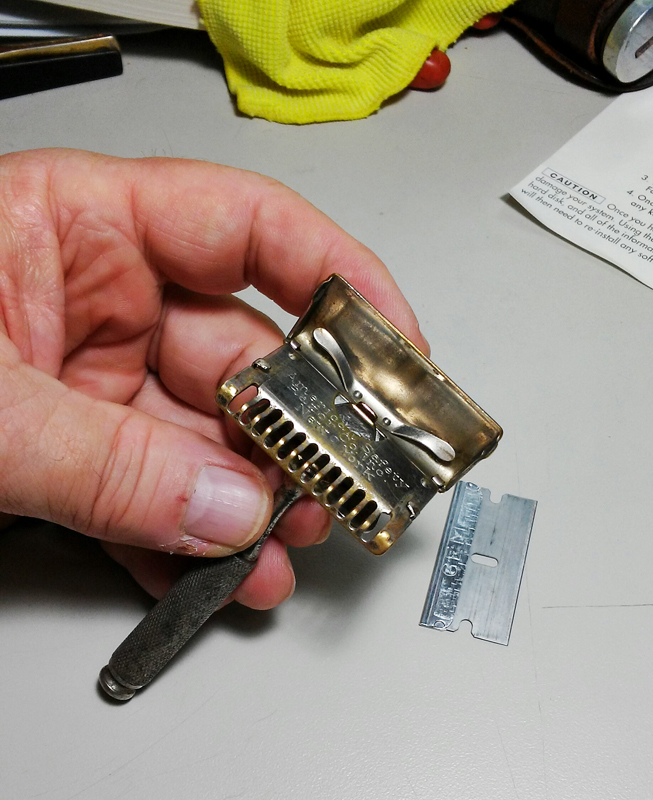
Many of the differences are simple to spot. The pre-war, for instance, had triangular holes in the base plate to aid in rinsing, and usually had a heavy ("fat") handle.


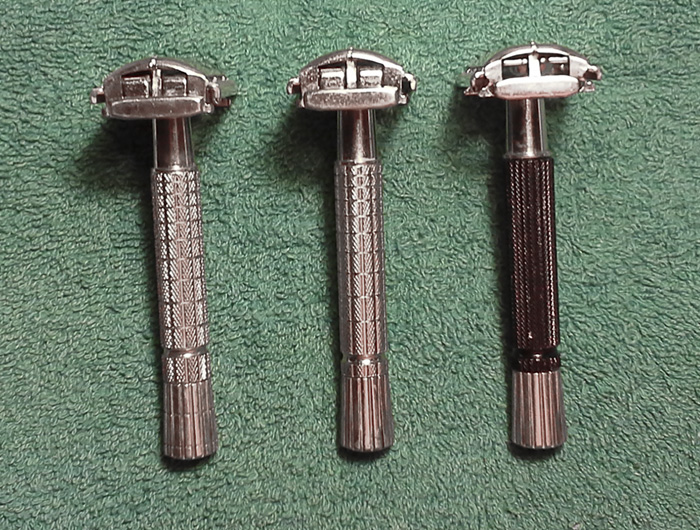
Civilian production was curtailed during World War II, and many variations of military models were produced. The 1945 Tech had a fluted, black-painted handle with a steel cap. Base plates could be nickel or black.


Here's the same Contract model (1946?), but in gold (next to an Old Type)...


A GI "Simplex" with Bakelite handle and base plate, steel cap, and carbon steel blades. It was issued in a snap-closure plastic case. (While not technically a Tech, it's the same three-piece design. Gillette manufactured a similar razor.)


After the war, civilian production was resumed. The Tech came with both a slim ball-end handle...


...and a Heavy handle (the "Gold Tech") like the pre-war...


Early Techs had no "Gillette" logo on the cap. An acid-etched logo appeared shortly after the war and was used to the early '60s. The oblong post-war holes can be seen here, too.


The embossed logo appeared around '63 or '64, and the material was changed from brass to Zamak (a zinc alloy). The cap also featured beveled, or "faceted" edges.


Tech production ceased in 1979. Pity, too, as this was a fabulous razor.

Note: Since these razors pretty much use similar parts, especially the interchangeability of the handles, parts can be easily swapped out to create what's known as "frankenrazors". I've seen black-handled Contracts with the gold-plated cap and base plate, and Heavy handles used on Old types. I recently bought a post-war ball-end in a clam-shell hard case, knowing they usually came in a cardboard box with a cellophane "window", but I wanted that case as well.
  

Thursday, December 8, 2016

Super Speed 101

The Gillette Super Speed is probably the best-known of all the double-edge razors...quite possibly the best-known of any and all razors. Introduced in 1947, the Super Speed brought ease and convenience of shaving to millions of men (and, with the Lady Gillette, women) around the world. But there are many variations of this venerable face-scraper: '40s style, flare-tip, black-handled, colored-tip, even slight variations of the flare-tip handle. Here's a little primer on the differences, and what to look for (and beware of).

The 1941 Ranger Tech could, in my opinion, be considered the grandfather of the first Super Speed. It's most readily identified by the smooth band above the twist-to-open knob, where the patent date is printed, and the absence of end caps...

Odd brass head/nickel handle combination

...which were added to the father of the Super Speed, the 1946 Ranger Tech.


(Note: The patent info was removed from the smooth band and placed inside on the base plate in 1946, further aiding in proper identification.)

These two Ranger models are basically identical to the Super Speed released in 1947, but there is one more sure-fire identifier: in 1947, the base plate was creased at the oblong drain holes. As you can see on this Ranger head, there are no creases (circled areas):


The crease in the '47 base plate...


Also, in 1947, there *may* be a flat "shoulder" between the handle and the neck, unsure if that's true with ALL 1947s, and the elimination of the smooth band above the TTO knob...


(Gold-plated versions of the Super Speed were known as "Milord", and were produced in 1940 and 1946-53. Be wary of Super Speeds being offered as "rare 1946-47". The base plate is the key. And '47 models with the end caps removed being passed off as '41 Rangers. Look for that smooth band. Gillette had a habit of mixing old parts with new models to save money, so look for those hybrids, too.)

The center bar for the Rangers and '47 SS, over which the blade is loaded, was squared at each end with two protruding "ears" that helped keep the blade in place. In 1948, Gillette "notched" the center bar to introduce their new blade dispenser, touting a "hands off" approach to blade-loading, and the "ears" removed. Not only did they claim this was safer, but it sped up the loading process. The "notched" center bar can be seen here on this 1951 aluminum-handled black-tip...


...which also came in a steel-handled version (brass was in short supply due to World War II, and the Korean conflict was just beginning; brass was needed for shell casings). The smooth band at the top of the handle identifies the handle's material; the steel-handle is knurled all the way to the neck.

 1951 steel-handle black-tip, 1957 blue-tip

Wait a minute...what's that with the blue tip? Why, that's the blue-tip flare-tip! More on those later.

Up to this point, Gillette didn't identify Super Speeds with date codes; a letter (for the year) and 1-4 (designating the quarter of that year) began in the third quarter of 1950 ("V3", fairly rare). Also, in 1950, Gillette changed the wording stamped inside the base plate, under the center bar, from "PAT NOS ON PACKAGE" to "PAT NOS ON PKG". And the only difference between the 1948 and 1949 SS was the case. A red bottom/clear top styrene case replaced the simple cardboard box in 1949. The razors themselves are identical. (Note: The correct razor dispenser was a cream-colored plastic case.)

(Note: There are two variations of the "V" test code. One with the stampings right-side up, and one with the stamping upside-down. Why? Who knows?)


1950 V3


In 1954, the '40s style was replaced with the flare tip; however, the Z3 and Z4 models were special edition "TV Specials" (also released as a flare-tip in 1958). The flare-tip is just that:


The TTO knob was flared, evidently to give the user a better grip. And the flare-tips had their variants as well (notice the handle differences)...

1956, 1961, and 1973 Super Speeds

1958 "TV Special"

1956 red-tip

 Now, about those colored tips. Gillette produced three levels of aggressive Super Speeds: a black-tip '40s style (1951-52, and the only SS with a plastic TTO knob) with an average level of aggression, a blue flare-tip with a mild level (in single-ring and a twin-ring knob versions), and a red-tip with an aggressive level (both produced between 1955-60). There are also European versions of the Super Speeds known as "Rockets".

 HD500 "Rocket", made in England

Finally, in 1966, Gillette made its final change with the handle becoming a black resin-covered aluminum (two variations are known, knurled and waffle patterns)... 


...with production ending in 1988, and the introduction of cartridge-based razors, sounding what many thought was the death knell for double-edge razors.

But they are still very alive and well.

Sunday, December 4, 2016

Adjustable razors

Adjustable razors have the ability of adjusting the blade exposure ("gap") to give a varying degree of mildness and/or aggressiveness by turning a numbered dial, located on the handle below the razor's head, or, in the case of injector razors, on the head itself.

  PAL adjustable razor

 Schick adjustable razor

Gillette adjustable DE razors

The "Fatboy", officially called the "195" (because they cost $1.95 when they came out in 1958) is so named for its chunky "fat" handle, and had a slightly higher-domed head than other twist-to-open razors. Gold-plated versions were called "Executive" models. Production ended in 1961 and was replaced with the slimmer "Slim" adjustable later that year. The gold-plated "Slim" was called "Aristocrat" (not to be confused with the earlier non-adjustable models). The "Slim", in turned was replaced in 1968 by the black-handled "Super-84 Adjustable", which had a short (84mm) handle; the "Super-109" had a 109.5mm handle. The "Super" model also came in a gold-plated version (from what I could find, date code O4 only?). The brass base plate was replaced in 1977 with a black plastic one. Production ended in 1988.

Some of the rarer adjustable razors...the infamous and elusive Bottom-dial Fatboy...

(image courtesy mr-razor.com)

Another highly-sought razor is the Gillette "Toggle", so named for its unique method of opening the silo doors...

 1960 (F4) red-dot "Toggle"

Flipping the lever loosens the doors just enough to aid in rinsing during shaving. Flipping it to the full position opens the doors for blade insertion/removal. The "Toggle" had a limited production run in 1957-58, and full production for Christmas, 1960. They all had the same 9-position adjustment dial as the other Gillettes. Most were gold-plated; however, there were some nickel-plated versions as well. A rarer still variation of the "Toggle", the 5-position 1956, was serial numbered, as opposed to having a date code...

  Not an inexpensive razor (image: mr-razor.com)

I personally used a 1965 "Slim" for about 6 years (along with an assortment of various disposables and women's cartridge razors), set on "3" and using whatever blades I could get at HEB's. I had an old brush (with probably half the bristles missing) and a puck of whatever soap I could get (again, at HEB's) in a vintage Homer Laughlin coffee mug. When I stopped seeing shaving as a chore, and more as a way to unwind & relax, I started using a wider variety of blades. Adjustables have the advantage of being able to adapt to the blade that's loaded in it. Also, they can adjust to areas of the face that benefit from a more aggressive (or milder) setting. I use a fairly mild setting on the flat surfaces, such as my cheeks, then crank it up on the more difficult areas, such as my throat (my whiskers grow in a sideways direction; such is the importance of "mapping" your face).

Monday, September 26, 2016

I'm on a single-edge kick

The last couple of weeks found me once again stalking the "auction site" in search of new additions for my middle grandson's collection (I'd passed on a half-dozen or so more since my last post). Mostly injectors and older single-edge. Lessee...a Star "1912", a sweet Schick adjustable, a PAL Injecto-Matic, an Ever-Ready "1914", a Schick Hydro-Magic, and in the mail, a 1917 Gillette Old Style and a Star 3-piece double-edge. I reckon I just thought I'd have enough razors. RAD has reared its ugly head once again.


I wish I'd kept at least one twin-blade injector. Those are getting hard to find.

Monday, September 5, 2016

Know what you're getting

I've spent a goodly amount of time snooping around second-hand shops, thrift and consignment stores, and antique shops, and have seen a lot of stuff that made me shake my head in wonderment. I always come away thinking, "These people can't be serious." I've also made some pretty good scores because someone didn't know what they had. I've been a member of a certain "auction site" since 2002, and learned a long time ago to research anything I'm interested in buying. There have been things I've hit the "Buy It Now" almost as soon as I saw them; I've also seen stuff that literally made me laugh out loud. I mean, just because it's old doesn't mean it's worth an arm and a leg. And if I didn't know what something was, I looked it up.

When cruising the auction sites, you'll see "rare", "vintage", and "antique" thrown around a lot, along with "appears unused", "mint", and "like new". I grew up in a time when "antique" meant something at least 100 years old (and, according to some definitions, still does). An 1889 Carson City Morgan silver dollar is rare; a Type E2 Schick injector? Not so much. As far as "collectible" goes, just remember: Anything can be collectible.

Be wary of mislabeled items as well. I've seen a 1912 GEM single edge razor listed as a "Micromatic" because that's what was on the case. And the Gillette Adjustable was nicknamed "Slim", not "Slim Boy". Never was, never will be. This also applies to condition. Other than the common descriptors like "NOS" (New Old Stock), I know of no grading system for razors. It's what the seller thinks it is. The guys & gals that have been doing this sort of thing for a while (and for a living) pretty much know what they're talking about. It's the ones who go to a yard sale now and then who don't. Watch for the "I'm no expert" and "look at the pics for description" for red flags. Now, this doesn't mean you can't get a good deal, because they're out there. But vague descriptions and fuzzy pics can (and do) hide defects. 

(Note: All this jibba-jabba I've been posting is for the guy like me, who finds something interesting to collect and use, not the mint condition, still in the box razor that will just sit on the self and be looked at. My son and his posse came up this weekend, and I gave my middle grandson a case containing 28 of my 41 razors, along with a box with like a year's worth of blades. I later got a text from my son: "Say, can I use these, or are they for display only?" I replied, "Grab one and get busy. They ain't doin' no good sittin' in a box."

I think the youngest can't wait to get his hands on my coffee pots.)

Friday, August 26, 2016

What's that razor worth?

Or rather...what's that razor worth...to you? How bad do you want it, and what are you willing to pay? And finally, what criteria are you basing your decision on? Condition? Rarity? With the case and instruction sheet included?

I pretty much just jumped into my first purchase, a 1951 Gillette Milord Super Speed. Most of the gold was worn away, but it was clean, operated flawlessly, and was relatively scratch-free. The seller was close by, had excellent feedback, and offered free shipping. I soon became a bit more selective, and doing research first before buying. The Milord was a good shaver, no doubt, but I could have done better. My second razor was a post-war, NDC (no date code, being made before 1951) ball-end Tech. It was in near-mint condition, but I probably paid more than if I'd been more patient and waited. (It is, by the way, a superb razor when coupled with the right blade.) So, I learned to wait, and resist impulse buying. There are exceptions to this; however, it again depends on what you're wanting. 

I've made nearly all of my purchases off "that auction site", checking the "ending soonest" first, then the "newly listed". And most have been determined by a combination of condition and price. If I find something that interests me, I'll do a specific search for other similar razors to find the best condition for the cheapest price. The most I've paid was $47.05 for a mint 1947 Milord, with the case. Too much? Maybe, but I was willing to pay that. I've lost a few because I thought the price was too high...for me. But someone else didn't. If you miss one, though, there will always be another one showing up. That's where patience pays off.

I really wasn't concerned with cases and instruction sheets, since I had made a stand (of sorts) to display all my razors. I think I have six in their correct (I think) cases. Which comes to this: Is that Type E Schick injector or Simplex Contract in its correct box? That's probably easier to determine than if that vintage Gillette Oxford is in the case that the Berkshire came in (in all probability, they're the same case; Gillette was known to use the same case for different razors). Cases do come in handy, though, especially for traveling. My NOS 1945 Contract Tech came with the correct hard clamshell case; it's my favorite when I'm on the road (performs extremely well with Polsilver blades). And in some instances, the case is a must-have. Why buy a short-handled "travel razor" if it doesn't have the case?

Sunday, August 7, 2016

Your mileage may vary

You'll see this a lot when you lurk about the shaving forums. What it simply means is not everyone will get the same results. While you might get a BBS (baby butt smooth) shave with a Red-tip and a Feather razor, I might come away with irritated skin due to mine being more sensitive that yours. There are a lot of variables to consider in your search for the best combination: a razor's blade gap (described as "mild", or narrow, and "aggressive", or wide); your whiskers (I can get by with shaving every other day, while you might have a 5 o'clock shadow at noon); skin condition (smooth and sensitive, or rough and tough?); the blade itself (a vintage carbon steel blade, to me, is much harder on my skin than a Teflon-coated stainless steel blade); pre-shave ritual (some shave before showering, some after, some use a pre-shave oil, some don't, some use hot water to shave, some use cold...you get the picture). All this stuff needs to be taken into consideration if you plan to actually use what you collect. If you only plan to collect NOS (New Old Stock), unopened/unused razors, and keep them locked up in a display case, then all this is moot. But, I like the feel of a vintage razor, both in my hand and on my face. And my entire collection is on display on my bathroom countertop, all within easy reach.

What you use to lather up affects your shave as well. The two main points to consider: It's gotta be moist, and it's gotta be slick. I mainly use Williams Mug Shaving Soap. Now, I've read many a disparaging comment regarding Williams, but they've been making this stuff since like 1840, so they must be doing something right. Once you learn how to lather it up, it works just fine. The trick is keeping it moist, because it can dry up rather quickly. HEB's used to carry it; now, all they have (in the way of pucks) is Van der Hagen scented and/or glycerin (depending on which store you go to). There are a ton of other soaps out there, in tube, puck, powder, or whatever other form they could come in. Go to Google Images and search "shaving soaps", and you'll be amazed at the variety (and cost). You can even get special little bowls, too.

Brushes. I have three. But there are probably as many brushes as there are soaps. My first was a cheapie black acrylic-handled "bristle hair" that came with a stand and bowl. Well, everyone else had more than one brush...and I had that balding Czech brush...so, I started looking for a knot (the bushy part without the handle). I settled for a Maggard synthetic, and mounted it using auto/marine sealant. It was as different as night and day. The synthetic felt like I was applying lather with a soft piece of foam rubber. Too soft, actually, as I had a hard time building up a decent lather. I then found a vintage "pure bristle" Strong Set brush and Old Spice mug at an antique shop in South Carolina, and I do believe this is the best-ever brush devised by man. My bristle-hair has been relegated to the job of "travel brush", and kept in a little pickle jar...