Saturday, June 3, 2017

Schick Krona: All but forgotten

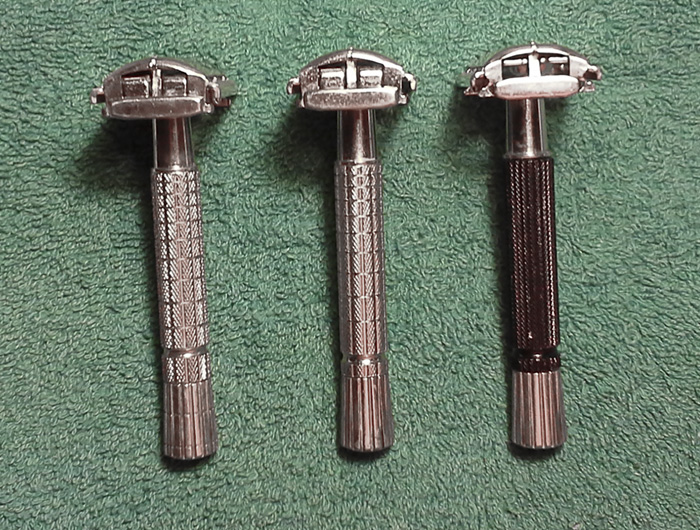
Gillette, it seems, has ruled the twist-to-open double-edge razor scene since its introduction in 1934 with the one-piece, open comb Aristocrat. But there was one that, performance-wise, gave King Camp's razor a real run for the money. It wasn't all pretty gold-plated (although there *is* a gold-plated version), nor did it have fancy knurling on the handle. In fact, it was rather plain and unassuming...

 First-generation Schick Krona

Nickel & Gold

There's not a whole lot of information about the Krona. Like Gillette, there are markings under the bottom plate. Mine is marked as such...


...a "1" over an "M" on the left, and another "1" over "5" on the right. It was thought that the "M" stood for the plant of manufacture (Milford, CT), but the true meaning is still unknown. I did find this plausible bit of information on one of the better-known shaving forums:
  • ca. 1964-65: original design with short metal knob, two-ply center bar, labelled with code M-5 and "Made in U.S.A" plus either a "SCHICK" or a triangle logo, blank doors, approximate weight 55-g.
  • ca. 1966: design revised with long metal knob, two-ply center bar, often labelled with code 6-M, "3-2" or "4-2", and "Made in U.S.A" plus either a "SCHICK" or a triangle logo, blank doors, approximate weight 50-g.
  • ca. 1966: as above, but grey instead of black and branded EVERSHARP with eagle logo.
  • ca. 1967-68: design revised for 1967 patents, plastic knob, one-ply center bar, often labelled with code 1-M, "PATENTS PENDING", doors stamped "Schick - Schick" or "Schick - Krona" or "Schick - (blank)", approximate weight 38-g.
  • ca. 1968-76 or later: plastic knob, one-ply center bar, various codes, doors stamped "Schick - Schick" or "Schick - Krona" or "Schick - (blank)", approximate weight 38-g.
Of course, this is not a definitive explanation, but it *is* one of the few sources of information on the Krona I've been able to find. The only 100% accurate, can't be denied, set in stone *fact* about the Krona is this:

It is one helluva razor. 

The blades that came with mine were early production "Plus-Platinum", marked "18" over "K", which is just as big of a mystery as the razor's markings. I seriously doubt they have anything to do with the date of manufacture, as I had ordered some later-production blades marked "17" over "R". These are *great* blades; smooth, sharp, Teflon-coated masterpieces. In fact, I have a package of three more 5-packs in my hand I just took out of my mailbox...


The top dispenser is what I received with my razor. According to my source, it's dated late '60's - early '70's. The font used on the blades changed in 1971, and in 1976, the phrase "with exclusive TEFLON coating" was first used. The bottom pack is the latest production, having dropped the "TEFLON" and added "Fits all Double Edge Razors". They are still the (reportedly) same great blade.

Another blade worth trying are the Super Chromiums...


...not quite on the same level as the Plus-Plats, but still worth keeping a few on hand. (Yet another version, the "Krona-Chrome", is available, but I've not tried it...yet.) I had my best shave ever last night with my '50 Gillette Super Speed and a Plus-Plat, so who knows? The Super might turn out to be the blade of choice for my '41 Ranger Tech. But I digress...

(Note: All of the NOS blades I've purchased had to be removed from the dispenser, separated (a pointy-blade X-acto knife works great), and cleaned with soapy water. Schick apparently used some type of preservative, a light oil perhaps, that turned to glue over time. Not a difficult task, but they would not slide out in the normal manner otherwise.)

The Krona is long, about 3/4" longer than a Super Speed, not quite 1/4" longer than a Slim adjustable. I thought having that long of a handle would be awkward (like the Super Adjustable 109), but on the contrary...it felt well-balanced and easy to use. Some folks say the handle is plastic, but from the feel of it, I'm inclined to agree that it's a resin-coated metal (brass, I'll wager). I didn't find it slippery in the least, although the TTO knob could be a bit grippier. It's not as readily available as a Gillette, and from what I've noticed, that's reflected in the prices of better condition razors. Still, one can be had for less than the price of a '40s Super Speed. An under-rated and under-appreciated razor worth keeping in your rotation.  

Saturday, March 4, 2017

Star, Gem, and Ever-Ready single-edge razors

These are probably the most popular (as well as the most widely available) of the vintage single-edge razors found on the market today. There are others, such as the Valet Auto-Strop and Enders, but they use a proprietary blade that may be difficult to find. The much older single-edge razors, too, use what are known as wedge blades (basically a piece of straight razor cut down to fit). For regular guys who want to use what they get, it's best to stick with those razors that use blades which are still available at the corner pharmacy. Now, for a little backstory...

The first safety razor was patented by the Kampfe Brothers way back in 1875, and soon they began producing (and improving upon) the Star Safety Razor. One of their long-time employees, Jerry Reichard, left them and formed the Gem Cutlery Company in 1898. His Gem Safety Razor was designed after the Star, and soon he was both out-producing and out-selling them. Several year later, Jerry leaves to form yet another company that later becomes Ever-Ready in 1905. And soon afterwards, Gem & Ever-Ready merge to become the Personna American Safety Razor Company in 1906. Up to this point, the aforementioned wedge blade had been used; ASR soon developed the now-known single-edge blade with the ribbed back. (Ever-Ready also produced shaving brushes.) And, finally in 1909, Gem/Ever-Ready merge with Star to become the American Safety Razor Corporation. Thus, the similarity in appearance of these razors.


The "flip-top" razor, so called because the cap "flips up" when a tab on the rear of the cap is pushed down, can be found in a multitude of variations. The Damaskeene (open comb, 1912; closed comb, 1915; "Gem Cutlery Co." on back to 1919, then changed to "Gem Safety Razor Corp."; last produced 1921 when "Damaskeene" was removed from the blade tray) is touted to be one of the (if not the) finest shaving instruments ever made. After 1921, this razor was commonly known as the "1912". A less refined model, the "Junior" came out in 1933. And although they may look alike, there are subtle differences in head design and geometry, as well as handle shapes and designs.

Gem "Damaskeene"

Gem "1912"

Gem "Junior"

Ever-Ready "1914"

Star "1912"

Gem "1912" (travel set?)

Gem "1912", curved cap with no logo on back plate

 Gem "1912" with "art deco" handle

The Ever-Ready "1924" model redesigned the head/handle attachment to produced the "Shovelhead"...


 ...and also hinged the cap in front of the blade tray instead of the rear, as in earlier models. And in 1932, Gem introduced (also in several variations) their first twist-to-open razor, the Micro-Matic...


...here, pictured with their unique "push-button" model from the 1950's.

Another variation of the Micro-Matic, with a "bullet"-shaped TTO knob...


 When the Ever-Ready trademark disappeared in the '30s, Gem came out with another very popular razor, the Heavy Flat-top, also known as the "G-Bar"...


 ...a heavy, well-balanced, yet mild razor, with a really cool retro look. The same head appears to be used in a much-lighter (and aptly named) '50s "Featherweight"...


 Finishing out the Gem line were the '60s Contour and '70s Contour II...

 Gem Contour

 
Gem Contour II

Although Gem no longer makes razors, they still produces excellent blades under the Gem/Personna name. Note: Not all single-edge blades are the same. Don't try shaving with "window-scraper" blades from the hardware store. Your face will thank you for that.

Saturday, February 25, 2017

Is the "Milord" just a blinged-out Super Speed?

Well, yeah, but they still rock.


I just received a near-mint '48/49 Milord in the mail. It had a few light green spots on the handle that the seller thought were due to it stored being in the case for a long time. Could be, I don't know, but I bought it anyway.

First thing I do with any razor I buy is give it a good soaking in a bowl of hot water and Dawn dishwashing liquid, then scrub it down with an old toothbrush. It didn't take much effort to totally remove all traces of green, and I soon had it looking like a brand new razor. Very faint marks (I wouldn't even describe them as scratches) on the doors, no dings in the knurling, opens & closes flawlessly. Very slight sign of wear on the case, and the lining was very clean. I would almost venture to say...unused. But, I digress...

The first Milord was introduced in 1940 (or 1941, depending on the source of info) as the "Gillette One-piece Tech Razor, Milord Model". (Note: Gillette also had a shortened handle "Milady" women's razor that same year.) 

 1940 (or is it '41?) Milord

The nickel-plated Ranger Tech was brought out the next year; both razors are otherwise identical. World War II interrupted civilian production until 1946, when the Ranger Tech returned (with the addition of end caps covering the door links). As before, the gold-plated Milord was offered, being a fancy version of its nickel-plated brother.

1947 saw the first Super Speeds, and of course, a gold-plated Milord was offered. The changes from year to year were the same as the nickel models (i.e. creased base plate in '47, notched center bar in '48, "Package" inside base plate changed to "PKG" in 1950, and date codes introduced in '51). The only other difference was the case: Milords came in a fancy clamshell while the Super Speeds were stuck in plastic blue or red bottom/clear top cases.The last Milord was the 1953 model.

So, making a short story long, yes. A Milord is a Super Speed in a fancy dinner jacket.

Sunday, February 19, 2017

Injectors. Gotta love 'em.

The injector razor, so named after the method of loading the blade, was the brain-child of Jacob Schick, a grunt who served during the turn of the century (not this last one...the one before). Blades are stored inside a (then brass, and later aluminum) case, fitted with a "key" which was stuck into a slot in the razor. A loading tab was pulled back, then slid forward, forcing the bade into the razor's head. Schick supposedly got the idea from the way rifles were charged. Nifty, huh? These razors and associated injectors were marketed and sold through Schick's Magazine Repeating Razor Company, founded on 1926. Col. Schick sold this company in order to raise capital for some stupid electric razor nonsense. But I digress...

There are several manufacturers who made injector razors, but Schick is probably the best known. The first Schick to use the injector method was the "D" Type (1935), which was opened in an odd scissor-fashion for cleaning...


(Note: The "Type" designation is not a company-created idea, but was created by a third-party to facilitate identification.)

Next, from 1935-1945, came the "E" Type. Now, here's where it starts getting a bit confusing. There are different spring designs: flat with outward-facing tabs; round with inward facing tabs (these springs could be swiveled to the left in order to open the head for cleaning); fixed spring with non-opening head; the irregular striations on the guard bar were replaced with parallel lines; and the head was either textured or smooth gold-plated. Handles were of molded Bakelite, with no seam. The round rivet was marked "Schick Injector", and inside of head had a single patent number and "Others Pending".

Schick "E2" head

From 1940-1941, The "F" Type was produced, having an alloy handle which also formed the guard bar, and an integral cap and spring...


Eversharp bought the rights to the Schick injector in 1946; while the head remained the same (with the exception of some razors having "Eversharp" replacing "Schick" on the rivet), the handle was changed to molded plastic of various colors and an obvious lengthwise seam. 


These were produced 1946-1955, and can be easily identified by the two patent numbers stamped inside the head. The "G" Type, as these are known, are somewhat milder than their predecessor, but this is another one of those "YMMV" things.

1947-53 saw the "Fashion Razor" ("H" Type) for the ladies, basically a small plastic box the took the injector razor...


1955 saw the first major change in 20 years with the "I" Type. The "I2" Type was known as the "Hydro-Magic", and was fitted with a lever which loosened the head for ease in cleaning.


The following years, up to 1980, saw little change with the exception of the handle becoming longer and slimmer...here's an "L" Type...


...although the code inside the head is stamped "M45"...


The "M" Type was the adjustable model...


In 1980, Schick (oops, I mean Warner Lambert, since Eversharp sold the rights to them in 1969), came out with the "N" Type with a redesigned "T"-shaped head...


...and the final model, the "O" Type, was produced for foreign markets, most notably Japan (where Schick injectors enjoy a strong following)...


So much for Schicks.Gillette also produced an injector razor...


...and another for twin blades...


Don't let the "Trac II" name confuse you with the "Trac II" cartridge razor. Different beast altogether.

PAL produced both a fixed and adjustable injector, as did Personna (fixed only). There are also newer injector razors on the market, but as they aren't vintage, they have no business here.

Injectors are just as capable of performing as well as double-edge razors, and the new Chinese-made Schick blades (known as "Chicks") are smooth, sharp, and comfortable. Single-edge blades can easily be found online, but the twin-edge are both scarce and expensive. I was fortunate enough to score a NOS, unopened box of Personna Twins off that auction site (as well as a good supply of Williams pucks)...


Note: All single-edge injector blades will fit any of these vintage razors. The twin blades, however, will ONLY work in razors made AFTER 1961, and NOT in the PAL adjustable razors or those razors fitted with a rinsing lever. There is a very real chance the blade will get stuck due to its being thicker than the single blade. Now, I tried one in my Schick E2, since the head will open, and it seemed to fit. I haven't tried it, though. So, there is my disclaimer. Proceed at your own risk.

Edit: I have since tried a twin blade in my E2, and it performed marvelously. I removed the blade after use to reduce any chance the (slightly) thicker twin could deform the head. I inserted the dummy blade, and found no ill effects. Second shave with the twin was equally great. E2 only, boys & girls, since the head can be opened to insert the blade by hand. I did not attempt to use the injector.

(Note: There were earlier injector razors; these had a mechanism built into the razor itself to load the blade, instead of using a separate injector. These were the Type A, B, and C repeating razors.)

 Type A

 Type B

 Type C

The head would swivel parallel with the handle, and loaded by pulling the opposite end, then pushing a new blade into the head. The head is then swiveled perpendicular to the handle, ready to shave. I've read that there are no nubs ("stops") in the razor's head, like later injectors, and some re-positioning of the blade might have to be done with a toothpick in order to get it in the proper position. Still, worthy of note and would be an interesting addition to any collection.)

Sunday, January 15, 2017

What to do with 'em when you get 'em

Use 'em. Simple.

Before I caught RAD, all I had was a '65 Slim adjustable. The only blades I used were either no-names or those horrid Van der Hagen "Ice Tempered" face-scrapers from Germany. I didn't wise up until I started lurking about that "auction site" and discovered about a million different blades. And believe me, there is a difference.

This is probably the best way to get a really good selection of blades. Start off with maybe a sample pack, and find the blades that work best for you. Another way to begin with is to read reviews of folks who have used these blades (and know what they're talking about). But remember the "YMMV" factor, and that some blades work better in some razors than others. Another factor is that there are occasional "duds", a bad blade now & then, due to a manufacturing error or defect in material. It happens. I think I've run across one in an otherwise great brand of blade. If you get a dud, don't be too quick to judge the whole lot.

But how do you know a good blade? Different razors perform differently with different blades. So...experiment. After a little more than a year, I've found a good combination wit the humble (and mild) post-war ball-end Tech and a Teflon-coated Voskhod blade. I've gotten a few vintage blades with some of the razors I've acquired, and tried them out of curiosity. They are now no more than historical artifacts.

Shaving forums are a great place to find razor reviews. Everything from straight razors and wedges, guys who've been doing it for years or only days, vintage razors to the latest & greatest Kickstarter product, soaps, brushes, pre-shave & post-shave oils & balms...it's all there. Great place to get loads of useful information. Also, a great place to BST (buy, sell, trade), get in a group buy, or participate in a PIF (pay it forward).

Set up a routine, a ritual if you will. Some guys (and gals) shave before they shower, some after. Some use hot water, others are cold water shavers. Some use a pre-shave oil, some don't. I've tried it all, and what works for me is to fill the lavatory with hot water (I run the ventilation fan so the mirror won't fog up), soak my brush, load up my razor, wet my face for like a half-minute, then lather up my brush (with a puck of good ol' Williams) in an Old Spice mug. I start below the sideburns, alternating sides with each series of short, over-lapping strokes, and work my way toward the chin. I usually have to "buff" my chin (shorter over-lapping strokes), then re-lather my neck and go down, with the grain (WTG), then up, against the grain (ATG). I sometimes over-do my throat because of the sideways growth of my whiskers, and, depending on the razor/blade combo (and my own persistence), irritate the skin (and sometimes draw blood). After a cold water rinse, I shower, then use Nivea Sensitive Cooling post-shave balm. Last night's shave ('46 Ranger Tech/'48 hybrid with a Polsilver Super Iridium) was the closest shave I've gotten with no red stuff leaking out (a bit of irritation, but no visible redness). What I use to do in like three minutes now takes 20-25 minutes.


Saturday, December 10, 2016

The Specs for Techs

Think Super Speeds are confusing? Let's talk Techs...

Introduced in 1938, the Tech is a simple three-piece razor consisting of a handle, base plate, and cap. Should be easy, right? Well...

Is the cap plain, etched, or embossed with Gillette's logo? Brass, steel, Zamak, or aluminum? Heavy handle, ball-end, fluted, or Bakelite? Standard length or short "Travel" size? Gold or nickel? Pre-war triangular drain holes or post-war oblong holes? English, US, French, Argentinian, German? Date code or no?

Many of the differences are simple to spot. The pre-war, for instance, had triangular holes in the base plate to aid in rinsing, and usually had a heavy ("fat") handle.


Civilian production was curtailed during World War II, and many variations of military models were produced. The 1945 Tech had a fluted, black-painted handle with a steel cap. Base plates could be nickel or black.


Here's the same Contract model (1946?), but in gold (next to an Old Type)...


A GI "Simplex" with Bakelite handle and base plate, steel cap, and carbon steel blades. It was issued in a snap-closure plastic case. (While not technically a Tech, it's the same three-piece design. Gillette manufactured a similar razor.)


After the war, civilian production was resumed. The Tech came with both a slim ball-end handle...


...and a Heavy handle (the "Gold Tech") like the pre-war...


Early Techs had no "Gillette" logo on the cap. An acid-etched logo appeared shortly after the war and was used to the early '60s. The oblong post-war holes can be seen here, too.


The embossed logo appeared around '63 or '64, and the material was changed from brass to Zamak (a zinc alloy). The cap also featured beveled, or "faceted" edges.


Tech production ceased in 1979. Pity, too, as this was a fabulous razor.

Note: Since these razors pretty much use similar parts, especially the interchangeability of the handles, parts can be easily swapped out to create what's known as "frankenrazors". I've seen black-handled Contracts with the gold-plated cap and base plate, and Heavy handles used on Old types. I recently bought a post-war ball-end in a clam-shell hard case, knowing they usually came in a cardboard box with a cellophane "window", but I wanted that case as well.
  

Thursday, December 8, 2016

Super Speed 101

The Gillette Super Speed is probably the best-known of all the double-edge razors...quite possibly the best-known of any and all razors. Introduced in 1947, the Super Speed brought ease and convenience of shaving to millions of men (and, with the Lady Gillette, women) around the world. But there are many variations of this venerable face-scraper: '40s style, flare-tip, black-handled, colored-tip, even slight variations of the flare-tip handle. Here's a little primer on the differences, and what to look for (and beware of).

The 1941 Ranger Tech could, in my opinion, be considered the grandfather of the first Super Speed. It's most readily identified by the smooth band above the twist-to-open knob, where the patent date is printed, and the absence of end caps...

Odd brass head/nickel handle combination

...which were added to the father of the Super Speed, the 1946 Ranger Tech.


(Note: The patent info was removed from the smooth band and placed inside on the base plate in 1946, further aiding in proper identification.)

These two Ranger models are basically identical to the Super Speed released in 1947, but there is one more sure-fire identifier: in 1947, the base plate was creased at the oblong drain holes. As you can see on this Ranger head, there are no creases (circled areas):


The crease in the '47 base plate...


Also, in 1947, there *may* be a flat "shoulder" between the handle and the neck, unsure if that's true with ALL 1947s, and the elimination of the smooth band above the TTO knob...


(Gold-plated versions of the Super Speed were known as "Milord", and were produced in 1940 and 1946-53. Be wary of Super Speeds being offered as "rare 1946-47". The base plate is the key. And '47 models with the end caps removed being passed off as '41 Rangers. Look for that smooth band. Gillette had a habit of mixing old parts with new models to save money, so look for those hybrids, too.)

The center bar for the Rangers and '47 SS, over which the blade is loaded, was squared at each end with two protruding "ears" that helped keep the blade in place. In 1948, Gillette "notched" the center bar to introduce their new blade dispenser, touting a "hands off" approach to blade-loading, and the "ears" removed. Not only did they claim this was safer, but it sped up the loading process. The "notched" center bar can be seen here on this 1951 aluminum-handled black-tip...


...which also came in a steel-handled version (brass was in short supply due to World War II, and the Korean conflict was just beginning; brass was needed for shell casings). The smooth band at the top of the handle identifies the handle's material; the steel-handle is knurled all the way to the neck.

 1951 steel-handle black-tip, 1957 blue-tip

Wait a minute...what's that with the blue tip? Why, that's the blue-tip flare-tip! More on those later.

Up to this point, Gillette didn't identify Super Speeds with date codes; a letter (for the year) and 1-4 (designating the quarter of that year) began in the third quarter of 1950 ("V3", fairly rare). Also, in 1950, Gillette changed the wording stamped inside the base plate, under the center bar, from "PAT NOS ON PACKAGE" to "PAT NOS ON PKG". And the only difference between the 1948 and 1949 SS was the case. A red bottom/clear top styrene case replaced the simple cardboard box in 1949. The razors themselves are identical. (Note: The correct razor dispenser was a cream-colored plastic case.)

(Note: There are two variations of the "V" test code. One with the stampings right-side up, and one with the stamping upside-down. Why? Who knows?)


1950 V3


In 1954, the '40s style was replaced with the flare tip; however, the Z3 and Z4 models were special edition "TV Specials" (also released as a flare-tip in 1958). The flare-tip is just that:


The TTO knob was flared, evidently to give the user a better grip. And the flare-tips had their variants as well (notice the handle differences)...

1956, 1961, and 1973 Super Speeds

1958 "TV Special"

1956 red-tip

 Now, about those colored tips. Gillette produced three levels of aggressive Super Speeds: a black-tip '40s style (1951-52, and the only SS with a plastic TTO knob) with an average level of aggression, a blue flare-tip with a mild level (in single-ring and a twin-ring knob versions), and a red-tip with an aggressive level (both produced between 1955-60). There are also European versions of the Super Speeds known as "Rockets".

 HD500 "Rocket", made in England

Finally, in 1966, Gillette made its final change with the handle becoming a black resin-covered aluminum (two variations are known, knurled and waffle patterns)... 


...with production ending in 1988, and the introduction of cartridge-based razors, sounding what many thought was the death knell for double-edge razors.

But they are still very alive and well.